
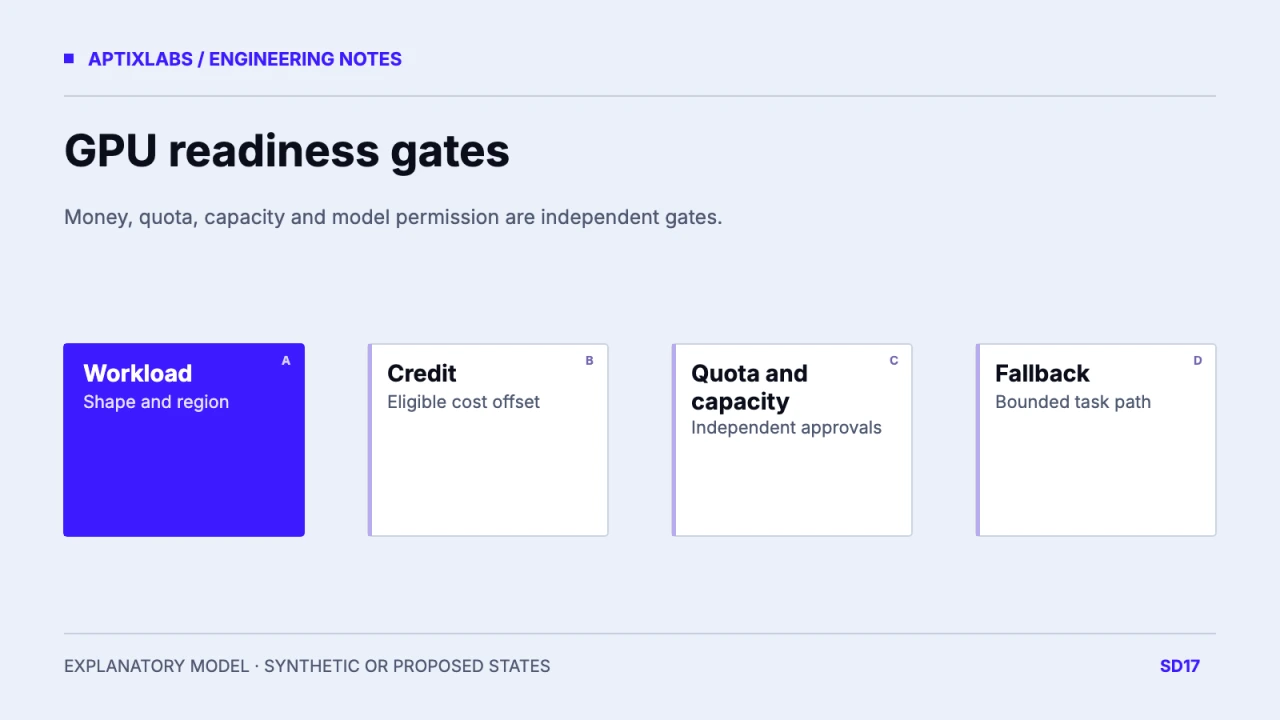
Verify money, quota, regional capacity and model access as separate gates. Startup cloud credits can offset eligible charges but do not reserve GPUs or guarantee that an approved workload can be deployed in the required region.
Define the workload before requesting hardware
Record the task, model or framework, accelerator memory, concurrency, expected duration, region and data-location constraints. Distinguish training, batch processing and interactive inference because they can tolerate different execution paths. A request for GPUs without a bounded workload is difficult to review and easy to overprovision. Include the smallest representative task that demonstrates feasibility. The operating plan should also state what the product does if the requested hardware is unavailable on launch day; a grant application is not a deployment readiness check.
Separate credit eligibility from technical allocation
Microsoft’s current startup technical-benefits page describes GPU access as subject to availability and routes higher quota requests through relevant teams. That wording should not be converted into a reservation promise. A promotional balance answers a coverage question. A service quota answers an allowed-consumption question. Regional capacity answers an availability question, while model access can add another approval or terms gate. Capture each result independently. An increased quota does not establish that capacity is presently allocatable, and a successful small deployment does not guarantee every larger shape in the region.
| Gate | Status | Next evidence |
|---|---|---|
| Eligible credit | Verify service and offer | Account terms |
| Regional quota | Blocked in scenario | Provider decision |
| Available capacity | Unconfirmed | Bounded allocation attempt |
| Task quality | Not run | Representative output review |
Build a gate-by-gate readiness record
Use a fictional workload requiring a GPU in region R. Its approved promotion has an unused balance, but the required quota is not approved. Mark the credit gate as verified only for the actual eligible service, the quota gate as blocked, capacity as unconfirmed and the representative task as not run. Do not assign an invented success rate or expected support approval date. Give the quota request a clear workload explanation and request identifier. The status register should make it impossible to interpret one green financial row as an overall launch approval.
Choose a fallback that still serves the task
Potential alternatives include a smaller model, bounded batch job, lower concurrency, a supported CPU task or a different region when the data and product requirements permit it. Compare quality, latency and operational implications through a representative test before describing an alternative as equivalent. Moving to a different provider can add data-egress and integration work, so do not treat it as a free switch. If no acceptable fallback exists, make the capacity dependency visible in the delivery plan. Narrowing a pilot may be more honest than promising a hardware allocation nobody has confirmed.
Record exactly what the provider approved
Keep the approved quota type, region, account, service and date with the deployment record. Retain a bounded allocation result and its conditions when an authorized test is eventually run. Recheck capacity and current model availability before a milestone that depends on them. The example in this guide is synthetic and no capacity request or deployment was made. It supports a readiness conversation without implying that AptixLabs can guarantee access. The final decision belongs to the actual workload evidence and the provider’s current account-specific allocation path.
Startup cloud credits comparison
API integration feasibility checklist
Bring the bounded workload, required region and unresolved capacity gate to scope a feasible fallback.
B2B SaaS development: scope and acceptance
Does higher quota reserve GPU capacity?
No. Quota and current regional allocation are different gates.
Can credits guarantee model access?
No. Verify service availability, model permissions, quota and account terms independently.