
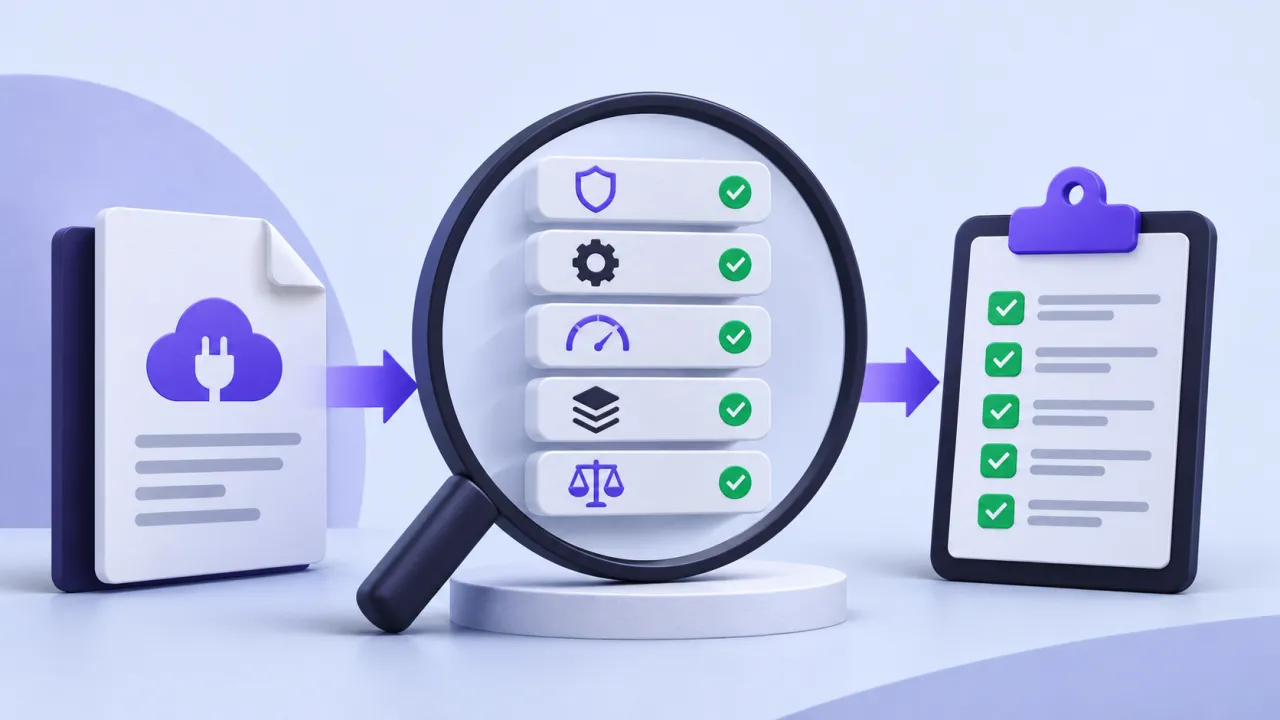
An API integration can be technically possible and still be impractical for the intended business workflow. Access approval, quotas, missing lifecycle events or weak export support can change feasibility. Verify these dependencies before estimating a polished end-to-end experience.
The contract to define first
Review authentication, object coverage, update mechanisms, pagination, quotas, sandbox behavior and terms relevant to the use case. Identify the source of truth and the reconciliation path when events are delayed or missing. A successful sample request proves only that request under those conditions; it does not establish every required lifecycle behavior.
A worked scenario
A hypothetical scheduling provider supports booking creation but not the cancellation event the product needs. The team must find a supported reconciliation method, change the user experience or narrow the scope. Ignoring that gap until launch creates an operational burden rather than a completed integration.
An implementation and review sequence
- Verify access object coverage and lifecycle behavior
- Test quotas errors and reconciliation with representative fixtures
- Make unresolved provider dependencies explicit
Failure cases worth testing
| Condition or input | Expected behavior |
|---|---|
| A required event is unavailable | A supported alternative or scope change is defined |
| Sample access is read-only | Write capability is not assumed |
| A quota is exceeded | The workflow has controlled delay or failure behavior |
Download the illustrative acceptance checklist (JSON)
Tradeoffs and limits
Not every dependency needs real-time behavior. Polling or a manual step may be acceptable if the business understands its delay, cost and ownership.
Use the result to make a decision
The practical output is straightforward: verify access quotas webhook behavior data export and test environments. Keep the assumptions with the artifact so a product owner, implementer or prospective partner can review the same decision. A useful handoff states the supported scope, the evidence collected and the remaining dependency instead of treating a successful demonstration as proof of every operating condition.
Continue with related implementation detail
Related guide: Choosing a SaaS development partner: the evidence to request
Fitness app internationalization architecture
SaaS technical debt prioritization
References and current platform requirements
thoughtbot: customer discovery
The linked references provide platform or process context. The worked scenario and acceptance matrix are original examples; adapt them to the actual product, supported environment and documented responsibilities.
Discuss the workflow
Bring one customer workflow and its constraints to define a reviewable discovery scope.
Explore the relevant AptixLabs service
What can make an API integration impractical?
An API integration can be technically possible and still be impractical for the intended business workflow. Not every dependency needs real-time behavior.
Which failure cases should be included in the review?
Include these explicit cases: A required event is unavailable: a supported alternative or scope change is defined; Sample access is read-only: write capability is not assumed; A quota is exceeded: the workflow has controlled delay or failure behavior.