
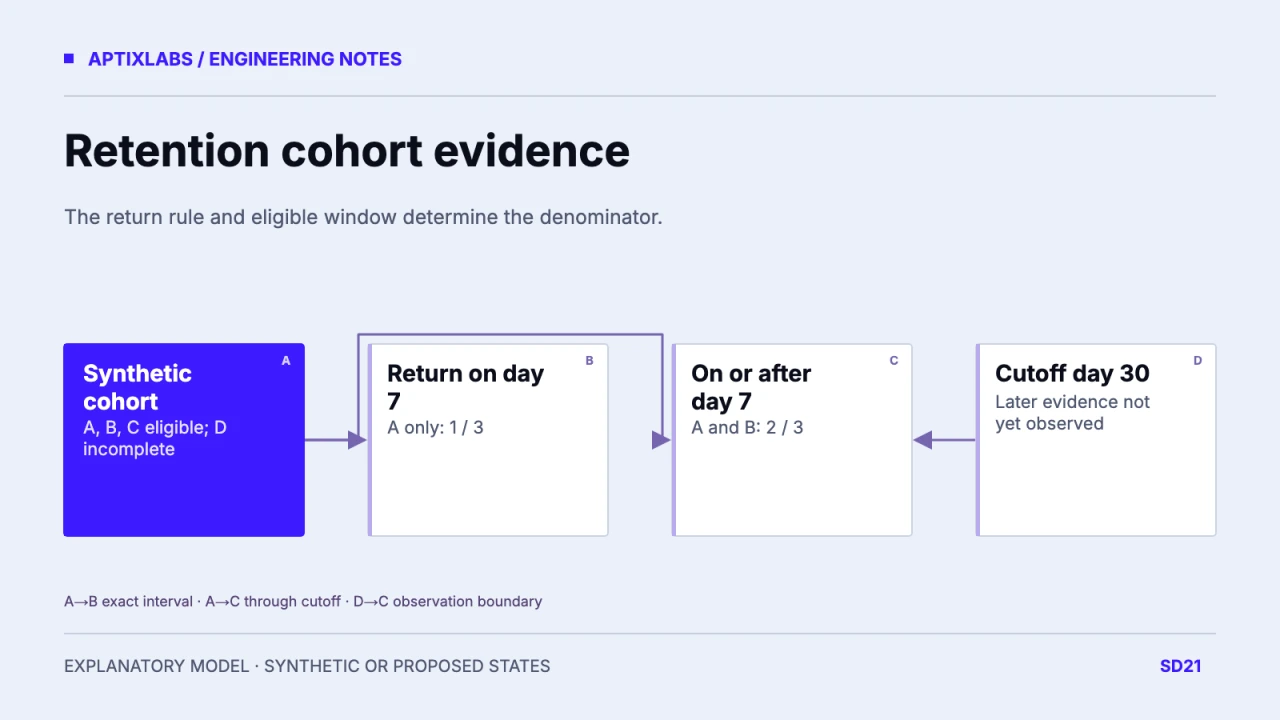
A retention evidence pack needs an explicit entry event, identity level, return rule and observation cutoff. Reproduce the cohort from a small event ledger before presenting a percentage in a founder review.
Define who enters the cohort and when
Choose account or user identity based on the product task. A workspace with several users should not silently switch between account retention and person retention. Define the first qualifying start event, timezone, exclusions and policy for merged identities. Signup and activation produce different entry cohorts, so preserve both if they answer different questions. Exclude known internal fixtures through an explicit rule. Keep the source extract date and query revision with the definition so a reviewer can reconstruct the denominator instead of receiving only a screenshot with a headline number.
Choose return on or return on or after
Amplitude’s current calculation guide distinguishes returning in a specific interval from returning in that interval or a later one. Name the method next to the result. A day-seven return-on result answers a different question from a return-on-or-after result. For the latter, the observation cutoff matters because later returns can become visible as data accumulates. Define whether days mean elapsed 24-hour periods or calendar buckets in your own implementation. Do not compare a rolling window in one report with a calendar-month cohort in another and describe the difference as changed product behavior.
| Account | Entry and returns | Eligibility and result |
|---|---|---|
| A | Entry 0; returns 7,14 | Eligible; on and after |
| B | Entry 0; return 9 | Eligible; after only |
| C | Entry 0; no return | Eligible; neither |
| D | Entry 24; return 26 | Incomplete day-seven window |
Trace the executed synthetic ledger
The isolated fixture uses four fictional accounts. A, B and C enter on day zero; A returns on days seven and fourteen, B on day nine, and C never returns. D enters on day twenty-four and returns on day twenty-six. With cutoff day thirty, D has not reached day seven and is excluded from that denominator. The actual local result is one of three for return on day seven, and two of three for return on or after day seven through the cutoff. The fixture retains its input and result; these are not company retention figures.
Return on day 7: 1 / 3 = 33.3%
Return on or after day 7, observed through day 30: 2 / 3 = 66.7%
D is excluded because 24 + 7 > 30.
Show incomplete cells instead of inventing churn
Represent an unobserved interval as incomplete, not zero. A zero says an eligible member did not return under the selected rule; an incomplete cell says the observation window is not yet available. Aggregate only comparable eligible rows and keep sample counts beside percentages. A small cohort can change sharply after one account’s return, so avoid decimal precision that suggests certainty. If late events or identity corrections change a row, version the refresh and explain why. Do not silently alter a prior deck while keeping the original date on its metric.
Package definitions, query and limitations together
Deliver the event contract, reproducible transformation, cohort table, source period and a short interpretation note. Include a row-level synthetic trace so the reviewer can inspect what a repeat return does and why D is excluded. Keep actual identities and private events behind appropriate access. The local script validates the stated synthetic arithmetic, not an Amplitude account or production data pipeline. Use the pack to discuss where users stop completing the meaningful task; it does not establish causation, market fit or a funding recommendation on its own.
MVP evidence investors can inspect
Startup technical data room checklist
Bring the cohort definition and a redacted event contract to scope a reproducible product-evidence pack.
B2B SaaS development: scope and acceptance
Should an incomplete retention interval be zero?
No. Mark it incomplete and exclude it from an aggregate that requires a completed observation window.
Can repeated returns increase one account’s denominator weight?
Not in this account-level cohort definition. Count the eligible account once under the selected return rule.