
A wearable partnership proposal becomes more credible when it explains what data is needed, why the user benefits and how the integration behaves when access changes. A logo slide and a list of device brands cannot answer those questions. Bring a small evidence pack that a technical and commercial partner can both review.
Start with the access route
Distinguish a phone health-platform integration from a direct vendor-cloud API. They can expose different records, permissions, delays and commercial conditions. Confirm which route supports the proposed user task and whether access requires an application, agreement or approved use case.
Garmin's current programme overview distinguishes personal access from business Starter and Enterprise routes. Their delivery and historical-data capabilities differ: the overview lists Starter delivery as push-only without historical data, while Enterprise options include additional capabilities. Verify the current route and terms for your use case rather than assuming that owning a device provides unrestricted business API access. This article does not claim that UltraFit360 has an approved Garmin integration or partnership.
Reference: Garmin's current developer programme overview
| Artifact | What the partner can assess |
|---|---|
| User journey | Why data is requested and where consent appears |
| Field and purpose map | Required records, intended use and excluded data |
| Provenance example | Source, timestamp, units and update identity |
| Freshness states | How pending, missing and stale data appear |
| Revocation trace | What stops when access is withdrawn |
| Recovery plan | Retry, correction and support ownership |
| Commercial questions | Eligibility, permitted use and operating responsibilities |
Demonstrate one record end to end
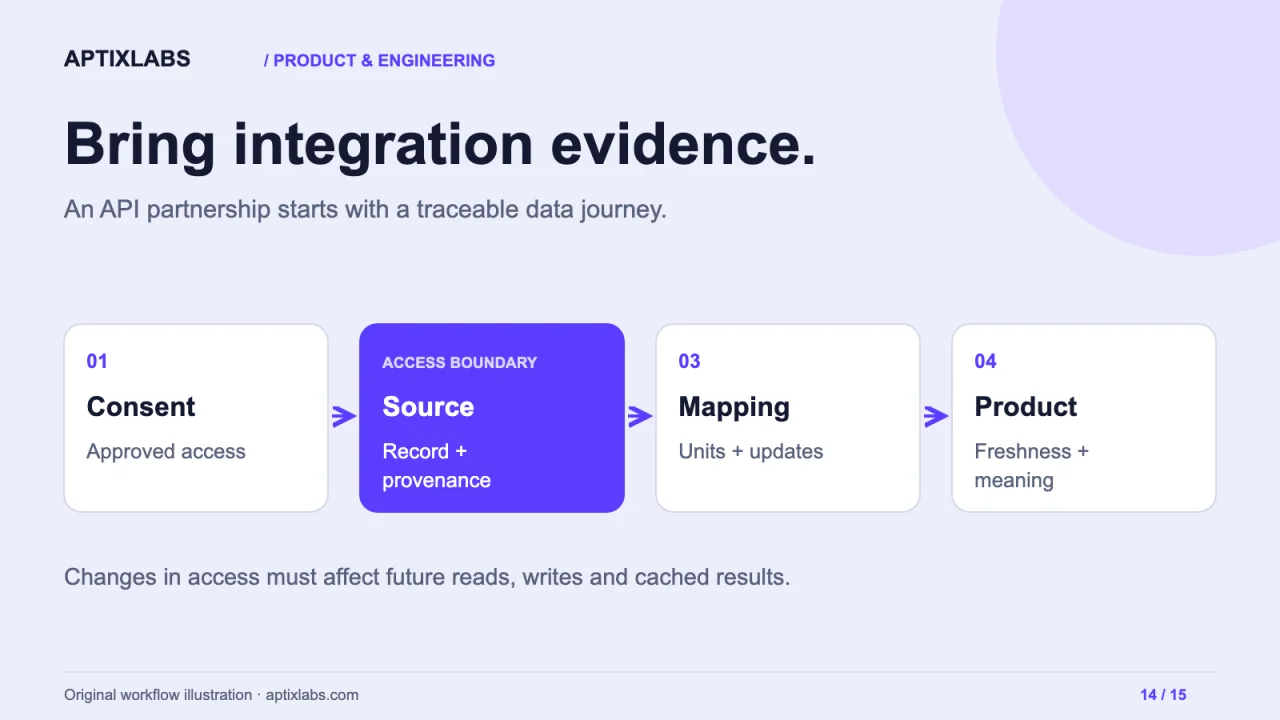
Use authorised test data to trace a record from its source to the product view. Show identifiers, time interpretation, unit conversion and any transformation. Keep raw observations distinguishable from derived scores. If a value changes after the first sync, demonstrate whether the application updates, replaces or preserves the earlier version.
Test overlapping sources rather than silently adding everything together. A workout can be represented through more than one path. Define how provenance influences selection and explain the policy in operational documentation. A partner should be able to inspect why the displayed value exists.
Make missing data an expected state
The source may not have synced, a record type may be unavailable or access may have changed. Show the last useful update and a clear next step where one exists. Do not turn missing inputs into a confident readiness or recovery result simply to fill the interface.
For HealthKit, an app cannot reliably infer every read-permission decision from the absence of data. For direct vendor integrations, token and account-link states may provide different signals. Keep explanations specific to the selected route instead of reusing one universal “permission denied” message.
Related: HealthKit and Health Connect integration scope
Review withdrawal and deletion separately
Stopping future access and removing previously stored data are different operations. Agree the purpose, retention policy and deletion process for the specific integration. Trace background jobs and derived caches too. A disconnected account should not continue producing new requests because an old worker retained credentials.
What AptixLabs can bring to the table
UltraFit360's reviewed implementation includes health-related input handling and derived score paths, giving us concrete questions about provenance and missing data. Those engineering references do not establish clinical validity or rights to a new vendor's API. Any prospective wearable or healthtech collaboration needs its own feasibility work and approved scope.
Read the UltraFit360 recovery architecture discussion
Bring the user outcome, required records and intended access route to a partnership conversation. We can discuss an integration evidence pack and a limited demonstration before anyone promises broader compatibility or commercial availability.
Is a HealthKit integration the same as a wearable-vendor partnership?
No. Phone health-platform access and direct vendor-cloud access have different requirements and data paths. A technical integration does not itself establish a commercial partnership.
What should a wearable integration demo prove?
Trace a permitted record through provenance, mapping and display, then test updates, missing data and access withdrawal. Confirm the API route and permitted use before promising compatibility.